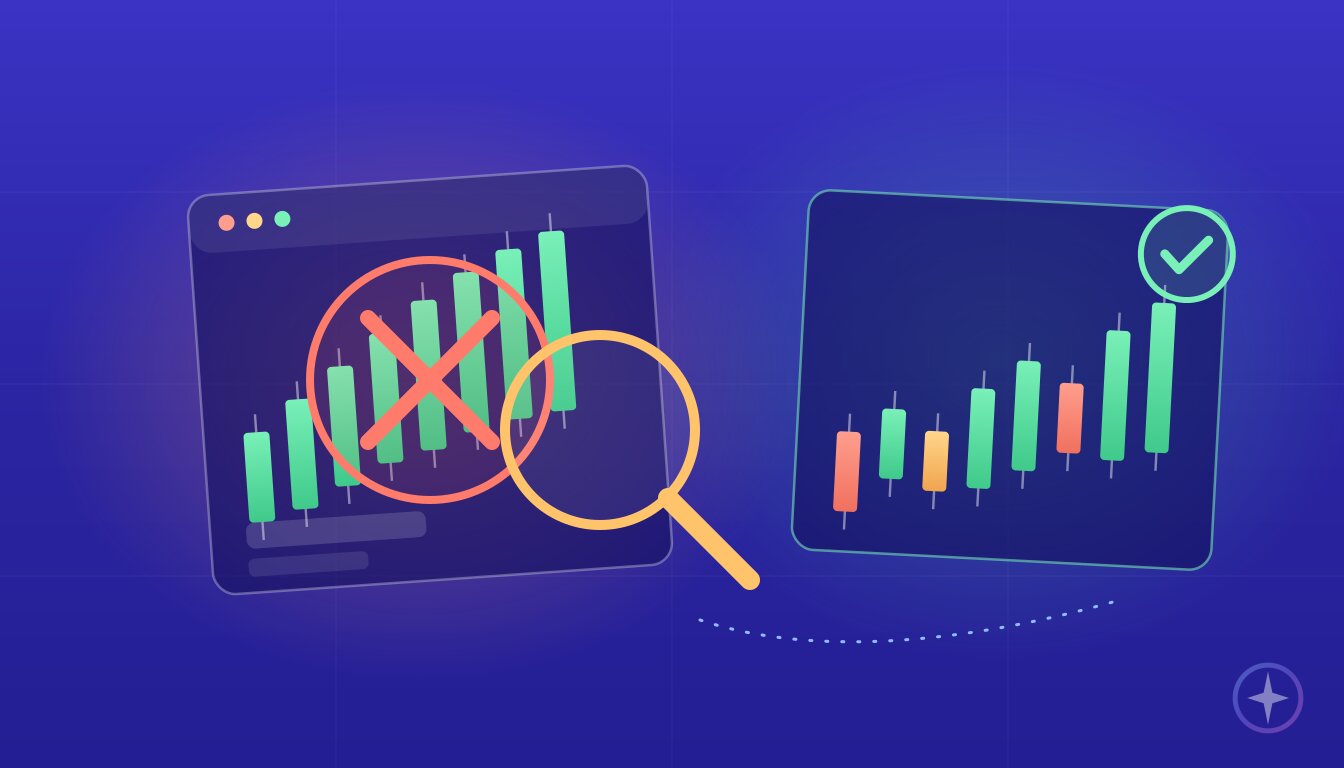
You have seen the posts. A green profit-and-loss screenshot, a stack of winning trades, and a link to a paid group promising the same results for you. Sooner or later every investor asks the same question: are trading signals legit, or is this whole industry a scam?
The honest answer is both. Trading signals as a service are legal and, in skilled hands, genuinely useful. But the industry has a structural problem: almost every provider self-reports their own results. When the person selling the signals also controls the record of how those signals performed, you are not looking at evidence. You are looking at marketing.
Key takeaways
- Signals are a legitimate service with a real fraud problem: self-reported track records cannot be trusted at face value.
- The seven red flags below catch most fake trading results before you pay anything.
- Real proof means timestamps recorded before outcomes, full history including losses, and verification you can run yourself.
The 7 red flags of fake trading results
Screenshots lie. The blockchain does not. Until you can verify a record cryptographically, use this checklist. One red flag deserves caution; two or more and you should walk away.
Screenshot-only proof
Images are trivially edited, generated on demo accounts, or borrowed from someone else entirely. If a screenshot is the only evidence, the track record is unverified.
No losing trades anywhere
Every real trader loses. A history showing only wins means losses were deleted, which means the provider curates the record after the fact.
Timestamps you cannot check
A winning call posted after the market moved proves nothing. Legitimate proof requires evidence the signal existed before the outcome was known.
Results that live only in Telegram
Admins can edit and delete chat history. A Telegram scroll-back is not an audit trail, no matter how long it looks.
Guaranteed returns
Phrases like "guaranteed 10% weekly" are not optimistic marketing. They are the signature of a scam. No honest trader guarantees future performance.
Pressure to pay quickly
Countdown timers, "last 3 spots" and pushy DMs exist to stop you from doing exactly what this article teaches: checking.
No independent verification of any kind
No third-party audit, no broker statement, no on-chain record. If every piece of evidence is controlled by the seller, the evidence is worthless.
Why screenshots lie so easily
Faking a profitable history takes minutes. A demo account produces real-looking dashboards with imaginary money. Free browser tools edit any number on any page. And survivorship curation, posting wins while quietly deleting losses, needs no technical skill at all. The economics make it worse: a fake track record costs nothing to produce and sells subscriptions immediately, while an honest one takes years to build.
Self-reported record
- Provider controls the database
- Losses can be deleted silently
- Timestamps say whatever they claim
- You must simply trust them
Proof-verified record
- Record sealed on a public blockchain
- Append-only: nothing can be removed
- Timestamps anchored before outcomes
- Anyone can verify, no trust needed
What legitimate proof actually looks like
A signal provider worth your money can show you four things, none of which depend on their honesty:
- Commitment before outcome. Evidence that each signal, with its exact entry, stop and target, existed before the market decided the result.
- A complete history. Every signal ever issued, wins and losses together, with no gaps.
- Independent data. Outcomes checked against market prices the provider does not control.
- Verification you can run yourself. A tool or public record that works without asking the provider for permission.
How HyperTradeAI removes the trust question
HyperTradeAI was built so that "are these signals legit?" has a mathematical answer instead of a social one. Every signal is sealed on the Solana blockchain the instant it is submitted (the Signal Seal, built on our PoSE and PoSR protocols). Outcomes are resolved by open-source code against independently pinned price data. Consistent performers earn Verified Trader Badges, performance NFTs that cannot be bought, only earned. And an AI engine scores every signal before distribution, so quality is filtered before anything reaches your account.
That is proof-verified copy trading: follow traders because their entire history is provable, then let AI Autopilot execute in your own broker account with risk managed to your profile. For the deeper cryptography, read how blockchain-timestamped trade history ends fake results.
Frequently asked questions
Are trading signals legit?
Some are. The service model is legal, but most providers self-report results with no independent verification, and that is where fraud lives. Judge legitimacy by proof, not promises or screenshots.
What is the most common signal scam?
Fabricated track records: cherry-picked or edited screenshots, demo results presented as real money, and deleted losing calls. The provider controls the record, so the record says whatever sells.
How does HyperTradeAI prevent fake results?
Every signal is sealed on Solana before the outcome is known and every result is resolved by open-source code against public price data. Nobody, including us, can edit, delete or backdate the record.
The bottom line
Signals are legit when the proof is. Demand records committed before outcomes, complete with every loss, and verifiable without trusting anyone. That standard is exactly what HyperTradeAI makes automatic.
This article is for informational purposes only and does not constitute financial or investment advice. All trading carries risk; past results do not guarantee future performance.