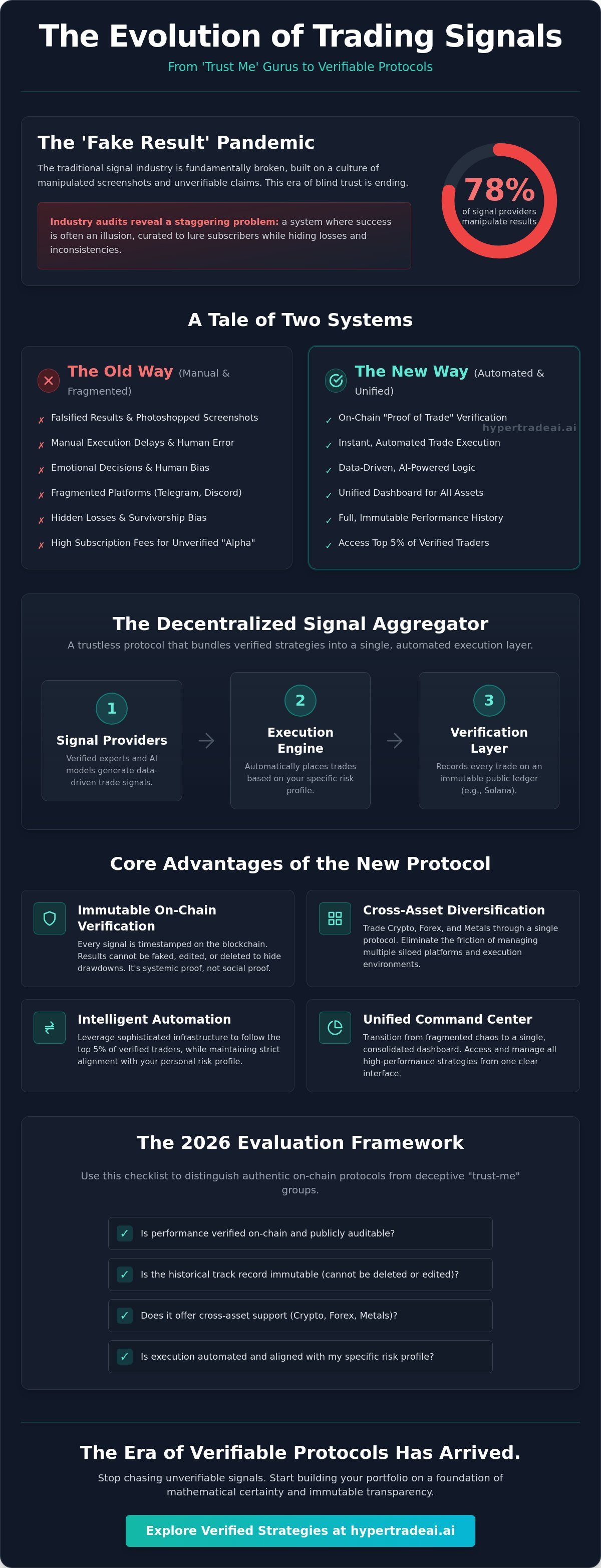
According to industry audits, traditional signal providers manipulate their trading results 78% of the time. The era of the “trading guru” is over. The era of the verifiable protocol has arrived.
You’ve felt the friction — chasing signals across disjointed Telegram groups, paying premium subscriptions for strategies backed by nothing but screenshots, and watching “verified” leaderboards quietly delete losing accounts. A decentralised trading signal aggregator dismantles this broken model by replacing blind trust with blockchain-verified, AI-driven execution across crypto, forex, indices, stocks, and metals.
This guide shows exactly how the shift works, what to look for in 2026, and how HyperTradeAI’s PoSE + PoSR architecture delivers the transparency the market has been missing.
Key Takeaways
- A decentralised trading signal aggregator bundles verified strategies into a single, automated execution layer — replacing fragmented manual trading.
- Eliminate falsified results by demanding Proof of Signal Entry (PoSE) and Proof of Signal Result (PoSR) — every signal anchored immutably on Solana.
- Diversify across five asset classes (Crypto, Forex, Indices, Stocks, Metals) through a single platform, removing siloed account management.
- Use the 2026 evaluation checklist to distinguish authentic on-chain transparency from deceptive off-chain reporting used by traditional signal groups.
- Automate execution through the HTAI Agent on your own VPS — broker keys never leave your hands, all risk parameters defined by you.
What is a Decentralised Trading Signal Aggregator?
A decentralised trading signal aggregator is a protocol that bundles verified strategies from multiple providers into a single execution layer. It functions as a trustless bridge between strategy providers and automated capital execution — replacing disjointed Telegram groups and manual copy-trading with systemic certainty.
Traditional DEX aggregators solve for liquidity — finding the cheapest price for a token swap. A signal aggregator solves for strategy and performance verification. It’s the difference between finding the cheapest gas and knowing exactly where to drive.
DEX Aggregator
- Optimises for liquidity
- Finds best swap price
- No strategy layer
- Single asset type
Signal Aggregator
- Optimises for strategy
- Verifies performance on-chain
- AI-driven execution
- Multi-asset coverage
The Shift from Liquidity to Intelligence
Finding the best price is only half the battle. If the trade itself is based on flawed logic, a low fee won’t protect your capital. The decisive move in 2026 is toward Signal-as-a-Service — treating premium intelligence as a utility, pooling demand, and removing the gatekeepers that inflate subscription fees.
Core Components of a Signal Aggregator
Signal Provider
Verified experts or AI models that generate trade ideas based on data-driven logic — every provider’s history anchored on-chain so performance cannot be fabricated.
Execution Engine
The automated system that places trades based on your specific risk parameters, capital constraints, and broker rules — removing emotional interference from order placement entirely.
Verification Layer
An immutable ledger (Solana) that records every signal entry, exit, and price point — making retroactive manipulation mathematically impossible via cryptographic Merkle proofs.
Eliminating the ‘Fake Result’ Pandemic: The Power of On-Chain Verification
The trading industry is plagued by a fake result pandemic. Self-styled gurus rely on manipulated screenshots, curated spreadsheets, and selective history to lure investors. Research indicates traditional signal providers manipulate their results 78% of the time. A decentralised trading signal aggregator replaces this “trust-me” era with a rigorous “verify-me” architecture.
By implementing Proof of Signal Entry (PoSE), every signal is cryptographically timestamped on the Solana blockchain at the precise moment of issuance — and when the signal closes, a corresponding Proof of Signal Result (PoSR) is anchored on-chain, recording the verified outcome. This creates an immutable, two-part track record that cannot be deleted, edited, or hidden to mask periods of drawdown.
“Reported” Results
- Self-submitted screenshots
- Losing periods quietly deleted
- History can be “reset”
- Zero independent verification
PoSE / PoSR Verified
- On-chain at signal issuance
- Wins AND losses recorded
- Permanent, uneditable
- Cryptographic certainty
How Solana-Based Timestamping Works
High-frequency trading demands a blockchain with high throughput and minimal cost. Solana serves as HyperTradeAI’s definitive ledger. Signals are recorded immediately at issuance and batched into Merkle trees that are anchored to Solana in six-hour windows via the PoSE batch job — ensuring every entry price, take-profit level, and stop-loss is permanently committed to a specific block. Retroactive manipulation is mathematically impossible: altering a Merkle tree root invalidates every leaf it contains.
Auditability: The New Standard for Signal Providers
There is a critical technical difference between a “verified” result and a “reported” result. Reported results are mere claims; verified results are cryptographic facts. HyperTradeAI utilises Solana to provide this immutable record for every signal — ensuring its decentralised aggregator remains a bastion of financial integrity you can audit directly, without trusting any intermediary.
Cross-Asset Aggregation: Five Markets, One Protocol
Most protocols remain siloed within a single blockchain ecosystem or a single market type. A true decentralised trading signal aggregator transcends these boundaries, providing a unified interface across five asset classes:
- Crypto — 24/7 perpetual futures across BTC, ETH, SOL, and major altcoins
- Forex — EUR/USD, GBP/JPY, and the full major/minor universe
- Indices — S&P 500, NASDAQ, DAX, and global equity indices
- Stocks — single-name equity CFDs via MT4/MT5 and supported brokers
- Metals — Gold (XAU/USD), Silver (XAG/USD), and commodity pairs
This cross-asset capability transforms the protocol from a niche crypto tool into a comprehensive financial hub where capital moves fluidly across sectors based on algorithmic intelligence rather than manual guesswork.
HyperTradeAI’s Two-Tier AI Validation Engine (CatBoost + Inline Gate)
HyperTradeAI’s two-tier AI validation engine processes every submitted signal through an inline quality gate (Tier-1) before it reaches subscribers — scoring it against the trader’s verified historical metrics in under a millisecond. An asynchronous CatBoost ML model (Tier-2) then enriches each accepted signal with a deeper confidence score that dynamically scales the investor’s position size:
- Higher-confidence signals receive a risk multiplier that increases exposure
- Normal-confidence signals execute at the investor’s base risk percentage
- Lower-confidence signals are scaled down, preserving capital automatically
The human provider brings the strategy. The AI applies the mathematical discipline to size and execute it correctly across varying liquidity environments — without hesitation or emotional interference.
Diversification via Subscription Allocation
True resilience comes from signal bundling. By subscribing to multiple traders across different markets and styles, investors build a diversified signal portfolio. Each subscription carries a mandatory allocation percentage — the sum across all active subscriptions is enforced never to exceed 100%, ensuring disciplined capital management by design.
How to Evaluate a Signal Aggregator: A Checklist for 2026
Choosing a platform on transaction costs or UI alone is a strategic error. Before committing capital, use this checklist to ensure the infrastructure delivers systemic certainty:
- Verification Method: Demand on-chain timestamping. Off-chain reporting or manual spreadsheets mean it’s a black box, not a decentralised protocol.
- Asset Breadth: Confirm support for Crypto, Forex, Indices, Stocks, and Metals — true diversification requires cross-market coverage.
- Execution Speed: Verify the automated execution engine is latency-optimised. A signal is only as valuable as the entry price you actually achieve.
- Governance: Look for community-led vetting. Token holders should have the authority to audit and remove underperforming or deceptive signal providers.
- Risk Management: Confirm native automated stop-loss and take-profit enforcement, plus signal quality filtering (LOW/NORMAL/HIGH) that scales position size automatically. You should not need to manually intervene to protect your downside.
- Key Custody: Your broker API keys and exchange credentials must never leave your own infrastructure. Any platform holding them on your behalf is a single point of failure.
Risk-Adjusted Performance Metrics
Total profit is a vanity metric that often masks dangerous underlying behaviour. A strategy yielding 50% returns but experiencing a 40% maximum drawdown is a liability, not an asset. Prioritise the Sharpe Ratio to understand return efficiency relative to risk taken — and remain vigilant for signal decay, where a once-profitable strategy loses its edge as market conditions shift.
Governance and Dispute Resolution
Decentralised governance is the only viable defence against platform-side corruption. Within the HyperTradeAI ecosystem, $HTAI holders vote on fee structures, provider inclusion, and protocol upgrades — creating a self-correcting environment that rewards integrity and removes bad actors meritocratically.
HyperTradeAI: The Premier Infrastructure for Verified Signal Execution
HyperTradeAI does not merely curate market data — it provides a comprehensive, full-stack execution and verification protocol. It replaces fragmented, unverified “alpha” groups with a sophisticated system where mathematical logic dictates every outcome, bundling only the top 5% of blockchain-verified strategies.
Automated execution is personalised to each investor’s unique risk profile, liquidity needs, and capital constraints. You define the boundaries. The AI executes the logic. This architecture removes the catastrophic risk of human bias or emotional hesitation during periods of high-stakes volatility.
PoSE + PoSR: Every Signal, Every Outcome — On-Chain
Every signal submitted to the platform generates a Proof of Signal Entry (PoSE) compressed NFT minted on Solana at the moment of issuance. When the signal closes, a Proof of Signal Result (PoSR) NFT anchors the verified outcome on-chain. This applies to every signal — wins, losses, and partial fills — creating a complete, unalterable on-chain history for every provider that nobody can selectively edit or delete.
The $HTAI Token Ecosystem
The $HTAI token powers real-time auditing, rewards top-performing providers who maintain consistent on-chain integrity, and gives holders a decisive vote in the future of the protocol — from fee structures to provider vetting.
Getting Started: Three Steps to Automated Signal Execution
Create your portal account and complete investor onboarding — set your risk tolerance, preferred asset classes, leverage limits, and execution parameters. Your risk profile governs every subsequent trade.
Browse the blockchain-verified leaderboard — review each trader’s immutable PoSE/PoSR on-chain history and subscribe to strategies that align with your financial objectives. Allocate capital across multiple traders to diversify exposure.
Deploy the HTAI Agent on your own VPS — connect your broker API keys (Binance, Bybit, IC Markets, Pepperstone, Exness, Hyperliquid), and activate automated execution. Your agent handles trades around the clock, strictly within the risk boundaries you defined. Your credentials never leave your own infrastructure.
The culture of “trust-me” trading groups has been decisively replaced by the era of systemic verification. You no longer need to navigate photoshopped results or the friction of manual execution across disjointed platforms. A decentralised trading signal aggregator gives you a professional-grade environment where logic and data prevail over emotion.
The future of trading is audited, automated, and entirely within your control.
All trading carries risk. Verified on-chain history reflects past performance and does not guarantee future results. Invest only what you can afford to lose.
Frequently Asked Questions
What is the difference between a DEX aggregator and a signal aggregator?
A DEX aggregator optimises for price and liquidity during a token swap. A decentralised trading signal aggregator optimises for strategic intelligence and performance verification — determining exactly when and why a trade should occur, not just where to execute it cheapest.
How can I verify that signals are actually on-chain?
Verification is achieved through HyperTradeAI’s dual-proof protocol. A Proof of Signal Entry (PoSE) compressed NFT is minted on Solana the moment a signal is submitted, anchoring the entry price, take-profit levels, stop-loss, and timestamp to an immutable block. When the signal closes, a Proof of Signal Result (PoSR) records the verified outcome on-chain. You audit the on-chain ledger directly — no self-reported spreadsheets.
Does the platform support forex and metals trading?
Yes. HyperTradeAI supports five asset classes: Crypto, Forex, Indices, Stocks, and Metals including Gold (XAU/USD) and Silver (XAG/USD). A dedicated real-time price feed service delivers market data that powers signal validation and HTAI Agent execution across all supported instruments.
Is my capital at risk with automated execution?
All trading involves risk, but automated execution is designed to mitigate human error and emotional bias. The HTAI Agent operates strictly within your pre-defined risk profile, capital constraints, and automated stop-loss parameters — executing exits instantly when conditions are met, even while you sleep.
How does the $HTAI token influence the platform?
The $HTAI token powers the ecosystem’s verification and governance layers. It funds cryptographic signal auditing, facilitates the reward system for high-performing providers, and enables DAO governance — $HTAI holders vote on fee structures, new provider inclusion, and protocol upgrades.
What happens if a signal provider has a losing streak?
Every loss is recorded on-chain via PoSR and reflected immediately in the provider’s verified performance metrics. A losing streak lowers their leaderboard ranking. If performance falls below community standards, $HTAI holders can vote to remove the provider from the aggregator index to protect the community.
Is this suitable for beginner investors?
Yes. Beginners select a risk profile, subscribe to verified traders, and activate the HTAI Agent for fully automated execution. The AI manages position sizing, stop-losses, and diversification automatically — all within the boundaries the investor defines at onboarding.
How does HyperTradeAI prevent signal providers from faking their results?
HyperTradeAI eliminates falsification by removing manual reporting entirely. Every signal is anchored to a Solana block at entry via PoSE. Providers cannot retroactively edit or delete trades to hide losses — the cryptographic Merkle tree root cannot be altered without invalidating the entire batch. The platform acts as an automated, trustless auditor.